Finding the best time to publish content is one of the most important challenges in digital communication today. As brands compete for attention across platforms, understanding the relationship between publishing time vs engagement becomes critical for improving visibility and performance. Using advanced media monitoring tools and social listening platforms like Pikasa Analytics and Analytics.Live, organizations can analyze real-time data to identify when audiences are most active, how engagement evolves after publishing, and which timing strategies deliver the best results. By combining audience behavior analysis, content performance insights, and social media monitoring, businesses can move beyond guesswork and optimize their content strategy for maximum impact.
Across news sites, social networks, and professional channels, the same story rarely peaks at the moment it is filed: engagement curves, reshares, and algorithmic surfacing redistribute attention hours or even days later. Teams that treat timing as a dataset rather than a fixed rulebook can compare when content appears, when reactions spike, and where efficiency is highest for their specific mix of topics, outlets, and markets.
When is the best time to publish?
It’s one of the most common and one of the most misleading questions in digital communication.
Most advice offers simple answers: post in the morning, avoid weekends, follow “optimal hours.” But real data tells a different story. Timing is not universal, it is contextual. It depends on your audience, your industry, your platform, and how your content is consumed.
What matters is not just when you publish, but when your audience engages.
The myth of the “perfect time”
The idea of a single best time to post is appealing, but overly simplistic.
In reality, content does not perform instantly. It circulates, gets picked up, reshared, and often reaches its peak hours after it is published. This creates a gap that many strategies ignore:
Publishing time is not the same as engagement time.
Understanding this difference is where meaningful optimization begins.
What the data reveals
When looking at media and social activity over time, certain patterns consistently emerge.
Publishing tends to cluster in predictable windows driven by editorial workflows, but the moment content goes live rarely determines how far it travels.
This shift becomes even more pronounced when you look at content categories. Political news, for example, often generates rapid but short-lived reactions, while entertainment and lifestyle content can build momentum more gradually. On social media, this dynamic fragments further, as each platform follows its own rhythm of visibility and amplification.
The key takeaway is simple:
Visibility is not driven by when content is published, it’s shaped by audience behavior, platform dynamics, and the nature of the content itself.
From visibility to timing intelligence
To move beyond assumptions, timing needs to be analyzed from multiple angles at once.
It’s not enough to know when content is published. You need to understand how that timing translates into engagement, how it varies across categories, and how platforms amplify different stories at different speeds.
This is where structured data becomes essential.
Within Analytics.Live, tools like Media Index and Social Media Index are designed to surface exactly these dynamics. By allowing you to explore publishing patterns alongside engagement trends, filtered by categories, rankings, platforms, and timeframes, they make it possible to identify where attention actually concentrates.
Instead of relying on general rules, you begin to see patterns specific to your market:
- When high-volume publishing does not translate into high engagement
- How top-performing outlets differ from the rest
- Which hours consistently drive stronger reactions
- How platform behavior reshapes visibility
The result is a shift from static “best time to post” advice to something far more useful: timing intelligence based on real behavior.
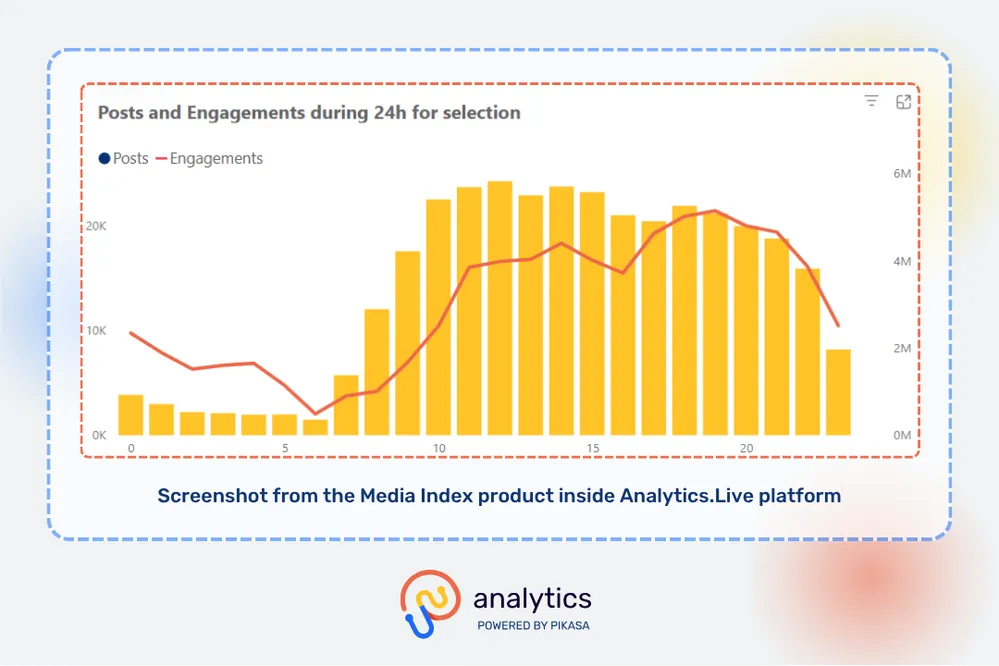 Screenshot from the Media Index product inside Analytics.Live platform.
How to identify your best windows
Based on these insights, a practical approach looks like this:
- Map publishing vs engagement — Identify when content is published and when it actually performs.
- Segment by category — Different topics behave differently. Politics ≠ lifestyle ≠ entertainment.
- Analyze platform behavior — Each platform has its own timing logic. Treat them separately.
- Focus on impact, not volume — More content does not mean better results. Look for efficiency.
- Test and adapt continuously — Timing is dynamic. What works today may shift tomorrow.
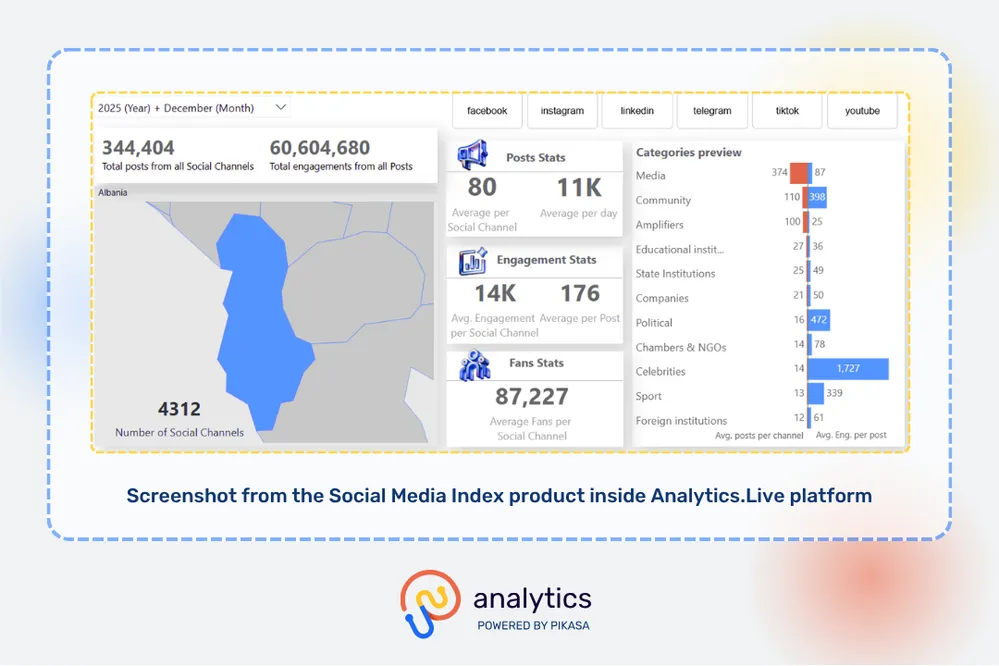 Screenshot from the Social Media Index product inside Analytics.Live platform.
Why this matters — and what to do next
Why this matters more than ever
In an environment where content volume is constantly increasing, timing becomes a competitive advantage.
The difference between visibility and invisibility is often not the content itself, but when it reaches the audience.
Organizations that understand this can:
- Maximize reach without increasing volume
- Improve engagement rates
- React faster to emerging narratives
- Optimize communication strategies
From guesswork to strategy
There is no single “best time to publish.”
But there is a best time for your audience, your content, and your platform.
The challenge is not finding a generic rule, but uncovering your own pattern.
And once you do, timing stops being a guess, and becomes a strategy.
If you want to explore your own publishing and engagement patterns in more detail, platforms like Analytics.Live provide structured insights through tools like Media Index and Social Media Index, helping you move from assumptions to data-driven decisions.